Which of the Following Is Considered One of the Most Famous Pieces of Art of the Renaissance
The Loftier Renaissance
The Loftier Renaissance refers to a brusk catamenia of exceptional creative product in the Italian states.
Learning Objectives
Describe the different periods and feature styles of 16th century Italian art
Key Takeaways
Key Points
- Many art historians consider the Loftier Renaissance to be largely dominated by 3 individuals: Michelangelo, Raphael, and Leonardo da Vinci.
- Mannerism , which emerged in the latter years of the Italian High Renaissance, is notable for its intellectual sophistication and its bogus (as opposed to naturalistic) qualities, such as elongated proportions, stylized poses, and lack of clear perspective .
- Some historians regard Mannerism as a degeneration of High Renaissance classicism, or even as an interlude between Loftier Renaissance and Baroque —in which case the dates are usually from c. 1520 to 1600 and it is considered a positive fashion complete in and of itself.
Key Terms
- High Renaissance: The menstruum in fine art history cogent the apogee of the visual arts in the Italian Renaissance. The High Renaissance catamenia is traditionally taken to have begun in the 1490s, with Leonardo'due south fresco of The Last Supper in Milan and the death of Lorenzo de' Medici in Florence, and to take ended in 1527, with the Sack of Rome by the troops of Charles V.
- Mannerism: A style of art developed at the end of the Loftier Renaissance, characterized past the deliberate distortion and exaggeration of perspective, specially the elongation of figures.
High Renaissance Art
High Renaissance art was the dominant style in Italy during the 16th century. Mannerism as well developed during this menstruation. The High Renaissance flow is traditionally taken to begin in the 1490s, with Leonardo'south fresco of The Last Supper in Milan, and to finish in 1527, with the Sack of Rome by the troops of Charles Five. This term was offset used in German ("Hochrenaissance") in the early 19th century. Over the last 20 years, use of the term has been oft criticized by academic art historians for oversimplifying creative developments, ignoring historical context, and focusing only on a few iconic works.
High Renaissance art is deemed every bit "High" considering it is seen equally the period in which the creative aims and goals of the Renaissance reached their greatest application. High Renaissance art is characterized past references to classical art and delicate application of developments from the Early on Renaissance (such equally on-point perspective). Overall, works from the High Renaissance brandish restrained dazzler where all of the parts are subordinate to the cohesive composition of the whole.
Many consider 16th century High Renaissance art to be largely dominated by three individuals: Michelangelo, Raphael, and Leonardo da Vinci. Michelangelo excelled equally a painter, architect, and sculptor and demonstrated a mastery of portraying the man effigy. His frescoes rank amongst the greatest works of Renaissance fine art. Raphael was skilled in creating perspective and in the fragile use of colour. Leonardo da Vinci painted two of the most well known works of Renaissance art: The Last Supper and the Mona Lisa. Leonardo da Vinci was a generation older than Michelangelo and Raphael, yet his piece of work is stylistically consistent with the High Renaissance.

The Last Supper, 1495–1498, Leonardo da Vinci
Mannerism
Mannerism is an artistic fashion that emerged from the afterward years of the 16th century and lasted as a popular aesthetic way in Italy until about 1580, when the Baroque began to replace it (although Northern Mannerism continued into the early on 17th century throughout much of Europe). Michelangelo's later works, such every bit The Terminal Judgment on the altar wall of the Sistine Chapel , and the Laurentian Library, are considered to exist Mannerist manner by some art historians.

Last Judgment, 1536-1541, Michelangelo
Some historians regard Mannerism equally a degeneration of High Renaissance classicism, or even as an interlude between High Renaissance and Baroque—in which example the dates are usually from c. 1520 to 1600 and it is considered a positive style complete in and of itself. The definition of Mannerism, and the phases inside information technology, continues to be the subject of argue amid fine art historians. For example, some scholars have applied the label to certain early on mod forms of literature (peculiarly poesy) and music of the 16th and 17th centuries. The term is besides used to refer to some Late Gothic painters working in northern Europe from about 1500 to 1530, especially the Antwerp Mannerists, a group unrelated to the Italian movement. Mannerist art is characterized by elongated forms, contorted poses, and irrational settings.
Painting in the High Renaissance
The term "Loftier Renaissance" denotes a catamenia of creative production that is viewed by art historians as the pinnacle, or the culmination, of the Renaissance period.
Learning Objectives
Describe the key factors that contributed to the development of High Renaissance painting and the menstruation's stylistic features
Key Takeaways
Key Points
- The Loftier Renaissance was centered in Rome , and lasted from about 1490 to 1527, the terminate of the flow marked past the Sack of Rome .
- The restrained dazzler of a High Renaissance painting is created when all of the parts and details of the work support the cohesive whole.
- The prime case of High Renaissance painting is The School of Athens past Raphael.
Key Terms
- High Renaissance: A flow of artistic product that is viewed by art historians as the height, or the culmination, of the Renaissance period. The flow is dated from 1490–1527.
The High Renaissance
The term "Loftier Renaissance" denotes a period of artistic production that is viewed by art historians as the height, or the culmination, of the Renaissance period. Artists such as Leonardo da Vinci, Michelangelo, and Raphael are considered High Renaissance painters. While the term has become controversial, with some scholars arguing that it oversimplifies artistic developments and historical context, it is hard to ignore the works of these High Renaissance artists equally they remain so iconic even into the 21st century.
High Renaissance Mode
The Loftier Renaissance was centered in Rome, and lasted from nigh 1490 to 1527, with the end of the menstruum marked by the Sack of Rome. Stylistically, painters during this period were influenced by classical art, and their works were harmonious. The restrained beauty of a High Renaissance painting is created when all of the parts and details of the work support the cohesive whole. While earlier Renaissance artists would stress the perspective of a work, or the technical aspects of a painting, High Renaissance artists were willing to sacrifice technical principles in gild to create a more cute, harmonious whole. The factors that contributed to the development of Loftier Renaissance painting were twofold. Traditionally, Italian artists had painted in tempera pigment. During the High Renaissance, artists began to use oil paints, which are easier to manipulate and allow the creative person to create softer forms . Additionally, the number and diversity of patrons increased, which allowed for greater evolution in art.
If Rome was the center for the High Renaissance, its greatest patron was Pope Julius Two. Equally patron of the arts, Pope Julius II supported many of import artists, including Michelangelo and Raphael. The prime example of High Renaissance painting is The School of Athens by Raphael.

The School of Athens, Raphael, 1509–1511: The School of Athens, painted by Raphael between 1509 and 1511, represents the way of High Renaissance painting that was centered in Rome during this period.
Raphael was commissioned past Pope Julius 2 to redecorate the Pope's living space in Rome. As office of this project, Raphael was asked to paint in the Pope's library, or the Stanza della Segnatura. The School of Athens is one of the frescoes within this room. The fresco represents the subject of philosophy and is consistently pointed to equally the epitome of High Renaissance painting. The work demonstrates many key points of the High Renaissance style; references to classical artifact are paramount as Plato and Aristotle are the central figures of this work. There is a clear vanishing bespeak , demonstrating Raphael'southward command of technical aspects that were and then important in Renaissance painting. Just above all, the numerous figures in the work evidence restrained beauty and serve to back up the harmonious, cohesive work. While the figures are diverse and dynamic, aught serves to detract from the painting every bit a whole.
Sculpture in the Loftier Renaissance
Sculpture in the High Renaissance demonstrates the influence of classical antiquity and ideal naturalism.
Learning Objectives
Describe the characteristics of High Renaissance sculpture
Cardinal Takeaways
Fundamental Points
- Sculptors during the Loftier Renaissance were deliberately quoting classical precedents and they aimed for ideal naturalism in their works.
- Michelangelo (1475–1564) is the prime instance of a sculptor during the Renaissance; his works best demonstrate the goals and ethics of the Loftier Renaissance sculptor.
During the Renaissance, an artist was not just a painter, or an architect, or a sculptor. They were typically all three. As a result, we see the aforementioned prominent names producing sculpture and the smashing Renaissance paintings. Additionally, the themes and goals of Loftier Renaissance sculpture are very much the same as Loftier Renaissance painting. Sculptors during the Loftier Renaissance were deliberately quoting classical precedents and they aimed for ideal naturalism in their works. Michelangelo (1475–1564) is the prime number example of a sculptor during the Renaissance; his works best demonstrate the goals and ethics of the High Renaissance sculptor.
Bacchus
The Bacchus is Michelangelo'southward first recorded commission in Rome . The work is made of marble, it is life sized, and it is carved in the round . The sculpture is of the god of wine, who is holding a cup and appears drunk. The references to classical antiquity are clear in the subject thing, and the body of the god is based on the Apollo Belvedere, which Michelangelo would have seen while in Rome. Not only is the subject affair influenced by antiquity, but and then are the artistic influences.

Bacchus by Michelangelo, 1496–97: Bacchus is Michelangelo's first recorded commission in Rome. The statue clearly demonstrates the classical influence that became and so important to sculptors during the Loftier Renaissance.
Pieta
While the Pieta is not based on classical antiquity in subject affair, the forms brandish the restrained beauty and ideal naturalism that was influenced past classical sculpture. Deputed past a French Cardinal for his tomb in Old St. Peter'southward, information technology is the work that fabricated Michelangelo's reputation. The bailiwick matter of the Virgin cradling Christ subsequently the crucifixion was uncommon in the Italian Renaissance, indicating that information technology was chosen by the patron .

Pieta by Michelangelo, 1498–9: This work past Michelangelo demonstrates the classical beauty and idealism that characterizes sculptures of the High Renaissance.
David
When the David was completed, it was intended to be a buttress on the back of the Florentine Cathedral . But Florentines during that time recognized information technology as so special and beautiful that they actually had a meeting near where to identify the sculpture. Members of the grouping that met included the artists Leonardo da Vinci and Botticelli. What about this piece of work made it stand out so spectacularly to Michelangelo's peers? The work demonstrates classical influence. The work is nude, in emulation of Greek and Roman sculptures, and the David stands in a contrapposto pose. He shows restrained dazzler and platonic naturalism. Additionally, the work demonstrates an interest in psychology, which was new to the High Renaissance, equally Michelangelo depicts David concentrating in the moments before he takes downwards the giant. The bailiwick thing was also very special to Florence as David was traditionally a borough symbol. The work was ultimately placed in the Palazzo Vecchio and remains the prime example of High Renaissance sculpture.

David by Michelangelo, c.1504: This work by Michelangelo remains the prime example of High Renaissance sculpture.
Compages in the Loftier Renaissance
Architecture during the High Renaissance represents a culmination of the architectural developments that were made during the Renaissance.
Learning Objectives
Describe the important architects of the Loftier Renaissance and their achievements
Key Takeaways
Key Points
- The Renaissance is divided into the Early on Renaissance (c. 1400–1490) and the Loftier Renaissance (c. 1490–1527).
- During the Early Renaissance, theories on art were developed, new advancements in painting and architecture were made, and the style was defined. The High Renaissance denotes a period that is seen every bit the culmination of the Renaissance menstruum.
- Renaissance architecture is characterized by symmetry and proportion, and is directly influenced past the study of antiquity .
- The architects most representative of the Loftier Renaissance are Donato Bramante (1444–1514) and Andrea Palladio (1508–1580).
The Renaissance is divided into the Early on Renaissance (c. 1400–1490) and the High Renaissance (c. 1490–1527). During the Early Renaissance, theories on art were developed, new advancements in painting and architecture were fabricated, and the style was divers. The Loftier Renaissance denotes a menstruum that is seen equally the culmination of the Renaissance catamenia, when artists and architects implemented these ideas and artistic principles in harmonious and beautiful means.
Renaissance compages is characterized by symmetry and proportion, and is directly influenced by the study of artifact. While Renaissance architecture was defined in the Early Renaissance by figures such equally Filippo Brunelleschi (1377–1446) and Leon Battista Alberti (1404–1472), the architects near representative of the High Renaissance are Donato Bramante (1444–1514) and Andrea Palladio (1508–1580).
Donato Bramante
A key effigy in Roman compages during the High Renaissance was Donato Bramante (1444–1514). Bramante was born in Urbino and first came to prominence as an builder in Milan earlier traveling to Rome . In Rome, Bramante was commissioned by Ferdinand and Isabella to design the Tempietto, a temple that marks what was believed to be the verbal spot where Saint Peter was martyred. The temple is circular, similar to early Christian martyriums, and much of the design is inspired past the remains of the ancient Temple Vesta.
The Tempietto is considered by many scholars to exist the premier case of High Renaissance architecture. With its perfect proportions, harmony of its parts, and straight references to ancient compages, the Tempietto embodies the Renaissance. This structure has been described as Bramante's "calling card" to Pope Julius Ii, the important Renaissance patron of the arts who would then employ Bramante in the historic design of the new St. Peter'due south Basilica .

The Tempietto, c.1502, Rome, Italy: Designed by Donato Bramante, the Tempietto is considered the premier example of Loftier Renaissance architecture.
Andrea Palladio
Andrea Palladio (1508–1580) was the Main Architect in the Republic of Venice in the 16th century. Deeply inspired by Roman and Greek compages, Palladio is widely considered one of the most influential individuals in the history of Western compages. All of his buildings are located in what was the Venetian Republic, but his teachings, summarized in the architectural treatise, The Four Books of Compages, gained him wide recognition beyond Italian republic. Palladian Architecture , named afterward him, adhered to classical Roman principles that Palladio rediscovered, applied, and explained in his works. Palladio designed many palaces, villas, and churches, merely his reputation has been founded on his skill as a designer of villas. Palladian villas are located mainly in the province of Vicenza.
Villas
Palladio established an influential new building format for the agronomical villas of the Venetian aristocracy. His designs were based on practicality and employed fewer reliefs . He consolidated the diverse standalone subcontract outbuildings into a single impressive structure and arranged as a highly organized whole, dominated by a strong heart and symmetrical side wings, every bit illustrated at Villa Barbaro. The Palladian villa configuration often consists of a centralized block raised on an elevated podium, accessed by grand steps and flanked past lower service wings. This format, with the quarters of the owner at the elevated eye of his ain globe, constitute resonance as a prototype for Italian villas and later for the country estates of the British dignity. Palladio adult his ain more flexible prototype for the plan of the villas to moderate scale and function.

Villa Barbaro: Front of Villa Barbaro in Maser, province of Treviso, Italy, built by Andrea Palladio between 1554 and 1560 for the brothers Daniele and Marcantonio Barbaro.
Leonardo da Vinci
While Leonardo da Vinci is admired as a scientist, an academic, and an inventor, he is most famous for his achievements as the painter of several Renaissance masterpieces.
Learning Objectives
Describe the works of Leonardo da Vinci that demonstrate his most innovative techniques as an artist
Key Takeaways
Key Points
- Among the qualities that brand da Vinci's work unique are the innovative techniques that he used in laying on the paint, his detailed knowledge of beefcake, his innovative employ of the human course in figurative composition , and his use of sfumato .
- Among the almost famous works created past da Vinci is the pocket-size portrait titled the Mona Lisa, known for the elusive smile on the woman's confront, brought about by the fact that da Vinci subtly shadowed the corners of the mouth and optics and so that the exact nature of the grin cannot be determined.
- Despite his famous paintings, da Vinci was non a prolific painter; he was a prolific draftsman, keeping journals full of small sketches and detailed drawings recording all manner of things that interested him.
Key Terms
- sfumato: In painting, the application of subtle layers of translucent paint then that there is no visible transition between colors, tones, and oftentimes objects.
While Leonardo da Vinci is greatly admired every bit a scientist, an bookish, and an inventor, he is about famous for his achievements as the painter of several Renaissance masterpieces. His paintings were groundbreaking for a variety of reasons and his works accept been imitated by students and discussed at swell length by connoisseurs and critics.
Among the qualities that make da Vinci'south work unique are the innovative techniques that he used in laying on the pigment, his detailed knowledge of beefcake, his utilize of the homo form in figurative composition, and his utilise of sfumato. All of these qualities are present in his most celebrated works, the Mona Lisa, The Final Supper, and the Virgin of the Rocks.

The Virgin of the Rocks, Leonardo da Vinci, 1483–1486: This painting shows the Madonna and Child Jesus with the babe John the Baptist and an angel, in a rocky setting.
The Terminal Supper
Da Vinci's nigh celebrated painting of the 1490s is The Terminal Supper, which was painted for the refectory of the Convent of Santa Maria della Grazie in Milan. The painting depicts the last repast shared past Jesus and the 12 Apostles where he announces that one of the them will betray him. When finished, the painting was acclaimed every bit a masterpiece of design. This work demonstrates something that da Vinci did very well: taking a very traditional bailiwick matter, such as the Concluding Supper, and completely re-inventing it.
Prior to this moment in art history, every representation of the Last Supper followed the same visual tradition: Jesus and the Apostles seated at a table. Judas is placed on the opposite side of the table of everyone else and is effortlessly identified by the viewer . When da Vinci painted The Last Supper he placed Judas on the same side of the table as Christ and the Apostles, who are shown reacting to Jesus every bit he announces that one of them will betray him. They are depicted as alarmed, upset, and trying to make up one's mind who will commit the human activity. The viewer too has to decide which effigy is Judas, who volition betray Christ. By depicting the scene in this manner, da Vinci has infused psychology into the work.
Unfortunately, this masterpiece of the Renaissance began to deteriorate immediately after da Vinci finished painting, due largely to the painting technique that he had chosen. Instead of using the technique of fresco , da Vinci had used tempera over a ground that was mainly gesso in an attempt to bring the subtle effects of oil paint to fresco. His new technique was non successful, and resulted in a surface that was bailiwick to mold and flaking.

The Last Supper: Leonardo da Vinci'due south Last Supper, although much deteriorated, demonstrates the painter's mastery of the human course in figurative composition.
Mona Lisa
Amid the works created past da Vinci in the 16th century is the small portrait known as the Mona Lisa, or La Gioconda, "the laughing one." In the present era it is arguably the near famous painting in the world. Its fame rests, in particular, on the elusive smiling on the woman'south face up—its mysterious quality brought most peradventure past the fact that the creative person has subtly shadowed the corners of the mouth and eyes so that the exact nature of the smile cannot be determined.
The shadowy quality for which the work is renowned came to be called sfumato, the application of subtle layers of translucent paint so that at that place is no visible transition betwixt colors, tones , and oftentimes objects. Other characteristics found in this piece of work are the unadorned dress, in which the optics and hands take no competition from other details; the dramatic landscape background, in which the earth seems to be in a land of flux; the subdued coloring; and the extremely shine nature of the painterly technique, employing oils, only applied much like tempera and blended on the surface then that the brushstrokes are indistinguishable. And again, da Vinci is innovating upon a type of painting here. Portraits were very common in the Renaissance. However, portraits of women were always in profile, which was seen as proper and modest. Hither, da Vinci present a portrait of a adult female who not only faces the viewer simply follows them with her eyes.

Mona Lisa: In the Mona Lisa, da Vinci incorporates his sfumato technique to create a shadowy quality.
Virgin and Child with St. Anne
In the painting Virgin and Kid with St. Anne, da Vinci's composition again picks upwardly the theme of figures in a landscape. What makes this painting unusual is that there are two obliquely set figures superimposed. Mary is seated on the knee of her mother, St. Anne. She leans forward to restrain the Christ Kid as he plays roughly with a lamb, the sign of his own impending sacrifice . This painting influenced many contemporaries, including Michelangelo, Raphael, and Andrea del Sarto. The trends in its limerick were adopted in particular by the Venetian painters Tintoretto and Veronese.

Virgin and Child with Saint Anne: Virgin and Child with St. Anne (c. 1510) by Leonardo da Vinci, Louvre Museum.
Raphael
Raphael was an Italian Renaissance painter and architect whose work is admired for its clarity of form and ease of composition.
Learning Objectives
Discuss Raphael influences and artistic achievements
Central Takeaways
Key Points
- Together with Michelangelo and Leonardo da Vinci, Raphael forms the traditional trinity of great masters of the High Renaissance . He was enormously productive, running an unusually large workshop, and despite his decease at 30, he had a large torso of piece of work.
- Some of Raphael's about hit creative influences come up from the paintings of Leonardo da Vinci; considering of this inspiration, Raphael gave his figures more dynamic and circuitous positions in his before compositions .
- Raphael'due south "Stanze" masterpieces are very large and circuitous compositions that take been regarded among the supreme works of the Loftier Renaissance. They requite a highly idealized depiction of the forms represented, and the compositions, though very carefully conceived in drawings, accomplish sprezzatura , the fine art of performing a chore and then gracefully it looks effortless.
Key Terms
- sprezzatura:The art of performing a difficult task and then gracefully that it looks effortless.
- loggia:A roofed, open gallery.
- contrapposto:The position of a figure whose hips and legs are twisted away from the direction of the head and shoulders.
Overview
Raphael (1483–1520) was an Italian painter and architect of the High Renaissance. His work is admired for its clarity of form and ease of composition and for its visual achievement of the Neoplatonic ideal of human grandeur. Together with Michelangelo and Leonardo da Vinci, Raphael forms the traditional trinity of great masters of that menses. He was enormously productive, running an unusually big workshop; despite his death at 30, a large torso of his work remains among the most famous of High Renaissance art.
Influences
Some of Raphael's nearly striking artistic influences come from the paintings of Leonardo da Vinci. In response to da Vinci'due south piece of work, in some of Raphael's earlier compositions he gave his figures more dynamic and complex positions. For example, Raphael's Saint Catherine of Alexandria (1507) borrows from the contrapposto pose of da Vinci's Leda and the Swans.

Saint Catherine of Alexandria: Saint Catherine of Alexandria (1507) borrows from the contrapposto pose of da Vinci'due south Leda.
While Raphael was too enlightened of Michelangelo'southward works, he deviates from his mode . In his Deposition of Christ, Raphael draws on classical sarcophagi to spread the figures beyond the front of the picture space in a complex and non wholly successful arrangement.

The Degradation by Raphael, 1507: This painting depicts the body of Christ being carried and a adult female fainting.
The Stanze Rooms and the Loggia
In 1511, Raphael began work on the famous Stanze paintings, which made a stunning impact on Roman art, and are generally regarded as his greatest masterpieces. The Stanza della Segnatura contains The School of Athens, Poetry, Disputa, and Constabulary. The School of Athens, depicting Plato and Aristotle, is one of his all-time known works. These very big and complex compositions take been regarded ever since as among the supreme works of the High Renaissance, and the "classic art" of the mail service-antique West. They give a highly arcadian delineation of the forms represented, and the compositions—though very carefully conceived in drawings—attain sprezzatura, a term invented past Raphael'south friend Castiglione, who divers it as "a certain nonchalance that conceals all artistry and makes whatever i says or does seem uncontrived and effortless."

View of the Stanze della Segnatura, frescoes painted by Raphael
In the subsequently stage of Raphael'southward career, he designed and painted the Loggia at the Vatican, a long thin gallery that was open to a courtyard on 1 side and decorated with Roman way grottesche. He also produced a number of significant altarpieces , including The Ecstasy of St. Cecilia and the Sistine Madonna. His last work, on which he was working until his expiry, was a large Transfiguration which, together with Il Spasimo, shows the direction his art was taking in his final years, becoming more than proto-Bizarre than Mannerist .
The Chief's studio
Raphael ran a workshop of over 50 pupils and administration, many of whom later became meaning artists in their own right. This was arguably the largest workshop team assembled under any single old master painter, and much higher than the norm. They included established masters from other parts of Italy, probably working with their own teams equally sub-contractors, as well as pupils and journeymen.
Compages
In architecture, Raphael's skills were employed by the papacy and wealthy Roman nobles. For instance, Raphael designed the plans for the the Villa Madama, which was to be a lavish hillside retreat for Pope Clement Seven (and was never finished). Even incomplete, Raphael's schematic was the virtually sophisticated villa blueprint yet seen in Italy, and greatly influenced the later evolution of the genre . Information technology also appears to be the only modern building in Rome of which Palladio fabricated a measured drawing.
Draftsman
Raphael was i of the finest draftsmen in the history of Western fine art, and used drawings extensively to plan his compositions. According to a nearly-gimmicky, when beginning to program a composition, he would lay out a large number of his stock drawings on the flooring, and begin to describe "apace," borrowing figures from here and in that location. Over forty sketches survive for the Disputa in the Stanze, and there may well accept been many more originally (over 400 sheets survived birthday).
As evidenced in his sketches for the Madonna and Child, Raphael used different drawings to refine his poses and compositions, apparently to a greater extent than most other painters. Most of Raphael's drawings are rather precise—even initial sketches with naked outline figures are carefully fatigued, and later drawings often accept a high caste of finish, with shading and sometimes highlights in white. They lack the liberty and energy of some of da Vinci's and Michelangelo's sketches, but are almost ever very satisfying aesthetically.

Raphael Sketch: This drawing shows Raphael's efforts in developing the composition for the Madonna and Child.
Michelangelo
Michelangelo was a 16th century Florentine artist renowned for his masterpieces in sculpture, painting, and architectural design.
Learning Objectives
Discuss Michelangelo's achievements in sculpture, painting, and compages
Central Takeaways
Key Points
- Michelangelo created his colossal marble statue, the David, out of a single block of marble, which established his prominence as a sculptor of boggling technical skill and strength of symbolic imagination.
- In painting, Michelangelo is renowned for the ceiling and The Last Judgement of the Sistine Chapel , where he depicted a complex scheme representing Creation, the Downfall of Man, the Conservancy of Man, and the Genealogy of Christ.
- Michelangelo's chief contribution to Saint Peter's Basilica was the use of a Greek Cross form and an external masonry of massive proportions, with every corner filled in by a stairwell or pocket-sized vestry. The outcome is a continuous wall-surface that appears fractured or folded at different angles.
Key Terms
- contrapposto: The standing position of a human figure where most of the weight is placed on 1 foot, and the other leg is relaxed. The effect of contrapposto in fine art makes figures await very naturalistic.
- Sistine Chapel: The all-time-known chapel in the Churchly Palace.
Michelangelo was a 16th century Florentine artist renowned for his masterpieces in sculpture, painting, and architectural design. His most well known works are the David, the Terminal Judgment, and the Basilica of Saint Peter'southward in the Vatican.
Sculpture: David
In 1504, Michelangelo was deputed to create a colossal marble statue portraying David as a symbol of Florentine freedom. The subsequent masterpiece, David, established the artist's prominence as a sculptor of boggling technical skill and strength of symbolic imagination. David was created out of a single marble block, and stands larger than life, equally it was originally intended to adorn the Florence Cathedral . The work differs from previous representations in that the Biblical hero is non depicted with the head of the slain Goliath, as he is in Donatello'southward and Verrocchio's statues; both had represented the hero standing victorious over the head of Goliath. No before Florentine artist had omitted the giant birthday. Instead of appearing victorious over a foe, David's confront looks tense and set for combat. The tendons in his cervix stand out tautly, his forehead is furrowed, and his eyes seem to focus intently on something in the distance. Veins bulge out of his lowered right manus, but his body is in a relaxed contrapposto pose, and he carries his sling casually thrown over his left shoulder. In the Renaissance , contrapposto poses were thought of as a distinctive feature of antiquarian sculpture.

The David by Michelangelo, 1504: Michelangelo'south David stands in contrapposto pose.
The sculpture was intended to be placed on the exterior of the Duomo, and has get 1 of the most recognized works of Renaissance sculpture.
Painting: The Terminal Sentence
In painting, Michelangelo is renowned for his work in the Sistine Chapel. He was originally commissioned to pigment tromp-l'oeil coffers subsequently the original ceiling developed a crack. Michelangelo lobbied for a dissimilar and more complex scheme, representing Creation, the Downfall of Man, the Promise of Salvation through the prophets, and the Genealogy of Christ. The work is office of a larger scheme of ornamentation within the chapel that represents much of the doctrine of the Cosmic Church.
The composition eventually contained over 300 figures, and had at its center nine episodes from the Book of Genesis, divided into three groups: God's Creation of the World, God'due south Cosmos of Humankind, and their fall from God's grace, and lastly, the state of Humanity as represented by Noah and his family. Twelve men and women who prophesied the coming of the Jesus are painted on the pendentives supporting the ceiling. Among the virtually famous paintings on the ceiling are The Creation of Adam, Adam and Eve in the Garden of Eden, the Neat Flood, the Prophet Isaiah and the Cumaean Sibyl. The ancestors of Christ are painted effectually the windows.
The fresco of The Last Judgment on the altar wall of the Sistine Chapel was deputed by Pope Clement VII, and Michelangelo labored on the project from 1536–1541. The piece of work is located on the chantry wall of the Sistine Chapel, which is not a traditional placement for the subject. Typically, last judgement scenes were placed on the exit wall of churches every bit a way to remind the viewer of eternal punishments as they left worship. The Last Judgment is a delineation of the second coming of Christ and the apocalypse; where the souls of humanity rise and are assigned to their various fates, equally judged by Christ, surrounded by the Saints. In contrast to the earlier figures Michelangelo painted on the ceiling, the figures in The Last Judgement are heavily muscled and are in much more artificial poses, demonstrating how this work is in the Mannerist way .
In this work Michelangelo has rejected the orderly delineation of the last judgement as established by Medieval tradition in favor of a swirling scene of chaos every bit each soul is judged. When the painting was revealed it was heavily criticized for its inclusion of classical imagery as well as for the amount of nude figures in somewhat suggestive poses. The ill reception that the work received may be tied to the Counter Reformation and the Quango of Trent , which lead to a preference for more than bourgeois religious art devoid of classical references. Although a number of figures were made more modest with the addition of drapery, the changes were not made until afterwards the death of Michelangelo, demonstrating the respect and adoration that was afforded to him during his lifetime.

The Last Judgement: The fresco of The Concluding Judgment on the altar wall of the Sistine Chapel was commissioned past Pope Clement VII. Michelangelo worked on the project from 1534–1541.
Architecture: St. Peter's Basilica
Finally, although other architects were involved, Michelangelo is given credit for designing St. Peter's Basilica. Michelangelo's main contribution was the use of a symmetrical programme of a Greek Cross grade and an external masonry of massive proportions, with every corner filled in by a stairwell or small vestry. The consequence is of a continuous wall surface that is folded or fractured at different angles, lacking the correct angles that usually define alter of management at the corners of a building. This exterior is surrounded by a giant order of Corinthian pilasters all set at slightly different angles to each other, in keeping with the always-changing angles of the wall's surface. Above them the huge cornice ripples in a continuous band, giving the advent of keeping the whole building in a state of pinch .

St. Peter's Basillica: Michelangelo designed the dome of St. Peter's Basilica on or earlier 1564, although it was unfinished when he died.
The Venetian Painters of the High Renaissance
Giorgione, Titian, and Veronese were the preeminent Venetian painters of the High Renaissance.
Learning Objectives
Summarize the impact of the paintings of Giorgione, Titian, and Veronese on art of the Venetian High Renaissance
Key Takeaways
Key Points
- The Venetian Loftier Renaissance artists Giorgione, Titian, and Veronese employed novel techniques of color, scale, and composition , which established them as acclaimed artists north of Rome .
- In detail, these three painters followed the Venetian Schoolhouse 'south preference of colour over disegno .
- Giorgio Barbarelli da Castlefranco, known as Giorgione (c. 1477–1510), is an creative person who had considerable impact on the Venetian High Renaissance. Giorgione was the first to paint with oil on sail.
- Tiziano Vecelli, or Titian (1490–1576), was arguably the virtually of import member of the Venetian school, as well as 1 of the most versatile. His use of color would accept a profound influence not just on painters of the Italian Renaissance, but on future generations in Western art.
- Paolo Veronese (1528–1588) was 1 of the master Renaissance painters in Venice , known for his paintings such equally The Wedding at Cana and The Feast in the House of Levi.
Fundamental Terms
- disegno: Drawing or design.
- Venetian School: The distinctive, thriving, and influential fine art scene in Venice, Italy, starting from the belatedly 15th century.
Giorgione, Titian, and Veronese were the preeminent painters of the Venetian High Renaissance. All three similarly employed novel techniques of color and composition, which established them as acclaimed artists northward of Rome. In particular, Giorgione, Titian, and Veronese follows the Venetian School's preference of color over disegno.
Giorgione
Giorgio Barbarelli da Castlefranco, known as Giorgione (c. 1477–1510), is an artist who had considerable impact on the Venetian Loftier Renaissance. Unfortunately, art historians do not know much virtually Giorgione, partly because of his early decease at around age thirty, and partly because artists in Venice were not as individualistic as artists in Florence. While only half dozen paintings are accredited to him, they demonstrate his importance in the history of fine art as well every bit his innovations in painting.
Giorgione was the get-go to paint with oil on canvas. Previously, people who used oils were painting on panel, not sail. His works do not contain much nether-drawing, demonstrating how he did not adhere to Florentine disegno, and his subject matters remain elusive and mysterious. One of his works that demonstrates all 3 of these elements is The Tempest (c. 1505–1510). This work is oil on canvas, x-rays prove there is very little nether drawing, and the subject matter remains i of the most debated bug in art history.

The Tempest, c, 1505–1510, Giorgione.: This piece of work past Giorgione encapsulates all of the innovations he brought to painting during the Venetian Loftier Renaissance and remains one of the most debated paintings of all fourth dimension for its elusive subject matter.
Titian
Tiziano Vecelli, or Titian (1490–1576), was arguably the most of import member of the 16th century Venetian school, equally well as ane of the most versatile; he was as adept with portraits, landscape backgrounds, and mythological and religious subjects. His painting methods, specially in the application and utilize of colour, would have a profound influence non only on painters of the Italian Renaissance, but on future generations of Western art. Over the course of his long life Titian'due south artistic manner changed drastically, just he retained a lifelong involvement in colour. Although his mature works may non incorporate the bright, luminous tints of his early pieces, their loose brushwork and subtlety of polychromatic modulations were without precedent
In 1516, Titian completed his well-known masterpiece, the Assumption of the Virgin, or the Assunta, for the high altar of the church of the Frari. This extraordinary slice of colorism, executed on a grand scale rarely earlier seen in Italy, created a awareness. The pictorial construction of the Supposition—uniting in the aforementioned composition two or three scenes superimposed on dissimilar levels, earth and heaven, the temporal and the infinite—was continued in a series of his works, finally reaching a classic formula in the Pesaro Madonna (better known every bit the Madonna di Ca' Pesaro). This perhaps is Titian's almost studied work; his patiently developed plan is ready along with supreme display of lodge and freedom, originality and style . Here, Titian gave a new conception of the traditional groups of donors and holy persons moving in aeriform infinite , the plans and dissimilar degrees set in an architectural framework.

Assunta, Titian: It took Titian two years (1516–1518) to consummate his Assunta. The painting's dynamic three-tier limerick and color scheme established him as the preeminent painter north of Rome.
Veronese
Paolo Veronese (1528–1588) was one of the primary Renaissance painters in Venice, well known for paintings such as The Wedding at Cana and The Banquet in the Firm of Levi. Veronese is known every bit a supreme colorist, and for his illusionistic decorations in both fresco and oil. His most famous works are elaborate narrative cycles, executed in the dramatic and colorful manner, full of majestic architectural settings and glittering pageantry.
His big paintings of biblical feasts executed for the refectories of monasteries in Venice and Verona are especially notable. For example, in The Wedding at Cana, which was painted in 1562–1563 in collaboration with Palladio, Veronese bundled the architecture to run by and large parallel to the movie plane , accentuating the processional character of the composition. The artist'due south decorative genius was to recognize that dramatic perspective effects would take been tedious in a living room or chapel, and that the narrative of the motion picture could best be absorbed every bit a colorful diversion.
The Nuptials at Cana offers little in the representation of emotion: rather, it illustrates the advisedly composed movement of its subjects along a primarily horizontal axis. Near of all, it is about the incandescence of light and color. Even as Veronese'southward use of colour attained greater intensity and luminosity, his attending to narrative, human sentiment, and a more subtle and meaningful physical interplay between his figures became evident.
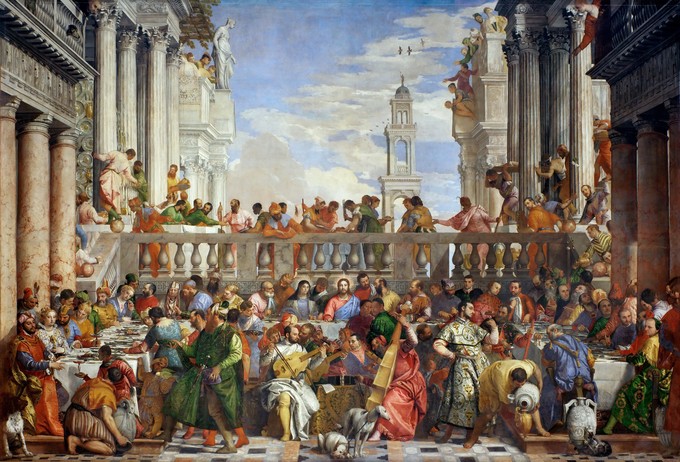
The Wedding at Cana, Paolo Veronese (1562–1563): The artist'due south decorative genius in The Wedding at Cana was to recognize that dramatic perspective effects would have been tiresome in a living room or chapel, and that the narrative of the picture could all-time be captivated as a colorful diversion.
Source: https://courses.lumenlearning.com/boundless-arthistory/chapter/the-high-renaissance/
0 Response to "Which of the Following Is Considered One of the Most Famous Pieces of Art of the Renaissance"
Post a Comment